
Buying shower enclosures under your own brand means handing a factory your drawings, your finish schedule, and your delivery date, then waiting to see what comes back. Most importers and project buyers have never walked the production floor, so the gap between a signed purchase order and a loaded container is a black box. That uncertainty is where late shipments, wrong finishes, and failed inspections are born.
This guide opens the box. It walks through the OEM shower enclosure manufacturing process from the first design conversation to the final container, stage by stage, using the way KJ Bath actually runs a custom order. You will see what happens during engineering, what a sample approval really checks, how mass production is sequenced across four workshops, and which documents should travel with your goods.
Whether you are a brand owner launching a private-label line, an importer consolidating a project, or a hotel contractor coordinating a multi-family build, knowing the process lets you set realistic timelines, ask sharper questions, and catch problems while they are still cheap to fix.
Key Takeaways
- OEM means the factory builds to your design and your brand; ODM means you license and brand a design the factory already developed. Both follow the same production backbone.
- The commercial path runs through seven stages: consultation, professional design, cost quotation, sample inspection, customer confirmation, mass production, and logistics delivery.
- Design for Manufacturing (DFM) and value engineering happen before tooling. This is where an experienced factory removes installation risk on paper instead of on the production line.
- Samples take about 15 working days; a first mass-production run takes about 30 working days and shortens to 20-25 days on repeat orders.
- Mass production is sequenced across four workshops: aluminum processing, glass processing, assembly, and automated packaging.
- Every order passes five QC tests and ships with a quality inspection report, certification copies, an installation manual, and a spare parts pack.
OEM vs ODM: What You Are Actually Buying
Before the process starts, be clear on the engagement model, because it decides who owns the design and how much engineering you bring to the table.
In an OEM (Original Equipment Manufacturer) arrangement, you supply the design, the dimensions, the finish, and the brand. The factory manufactures to your specification and applies your logo. Importers choose OEM when they want a differentiated product that competitors cannot source off the shelf.
In an ODM (Original Design Manufacturer) arrangement, the factory has already developed the model. You select it, possibly adjust a finish or a dimension, and brand it as your own. ODM lets a seller launch quickly without an in-house engineering team.
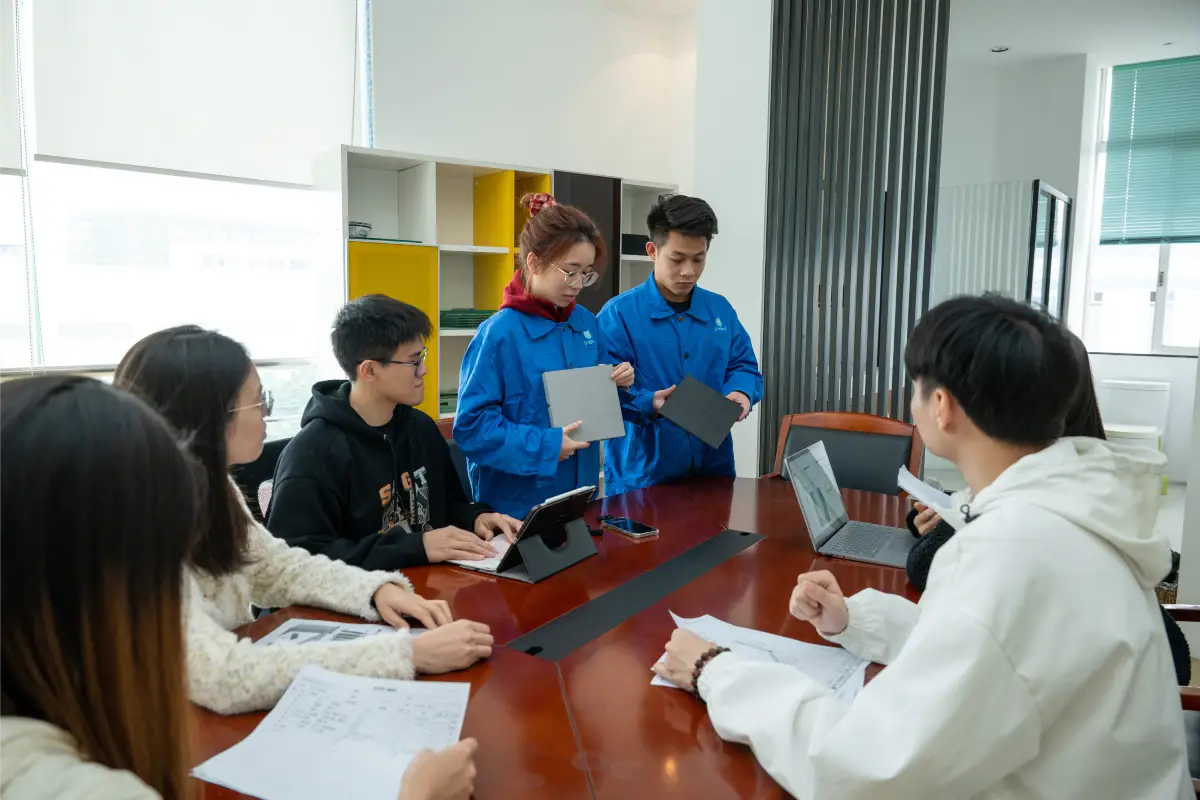
| Factor | OEM (Your Design) | ODM (Factory Design) |
|---|---|---|
| Design ownership | You own the drawings | Factory owns the base model |
| Time to launch | Longer, needs engineering and sampling | Faster, model already proven |
| Differentiation | High, unique to your brand | Medium, shared base with custom finish |
| Your engineering load | Heavy, you supply specs | Light, factory supplies specs |
| Best for | Established brands, exclusive projects | New sellers, fast market tests |
KJ Bath supports both. The factory holds multiple utility model patents, including a grooved silent roller and a self-cleaning shower structure, so an ODM buyer can start from a proven design, while an OEM buyer gets a 12-person R&D team behind a custom build. If you are still deciding which route fits your catalog, our guide on what to look for in a shower enclosure manufacturer covers the evaluation criteria.
Stage 1: Consultation and Design Brief
Every order begins with a conversation, not a purchase order. The factory’s business cooperation flow starts at customer communication and consultation, and this stage sets the terms for everything that follows.
You bring the inputs: a bathroom floor plan, your glass thickness preference, your finish schedule, and your certification requirements. For a hotel project, that usually means CAD drawings, a SPEC document, and a delivery schedule. For a private-label catalog, it means reference photos, target dimensions, and packaging requirements.
For engineering-led projects, the R&D team steps in early with a structural pre-check. They look for waterproofing dead spots and installation feasibility issues and return an optimization proposal within 24 hours. KJ Bath commits to a 12-hour response time on all international inquiries, which matters when you are coordinating across time zones and a project clock is running.
This is also where confidentiality is settled. Exclusive hotel project designs are covered by strict NDA protocols, so a brand owner can share a proprietary profile without worrying about it reaching a competitor. The concern that a factory might bypass you and deal with your end client directly is a real one for importers, and a signed NDA plus a clear communication channel is the standard protection.
Stage 2: Engineering, CAD, and Value Engineering
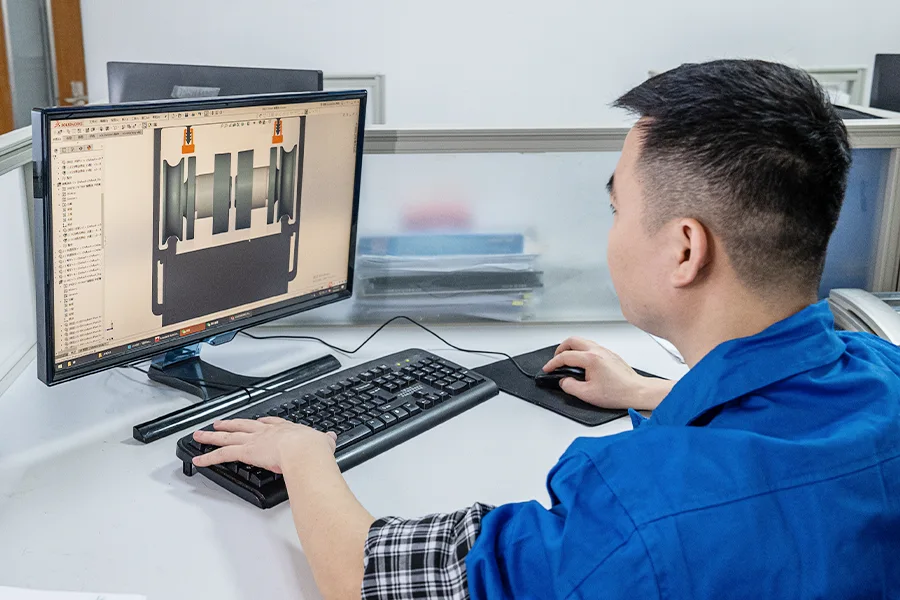
The second stage in the flow is professional design. This is where your brief turns into buildable drawings.
Two practices separate a serious manufacturer from an assembly shop at this stage.
Design for Manufacturing (DFM)
DFM is a review where the factory checks your drawings for anything that is hard, costly, or risky to build, then proposes changes before tooling starts. A profile that looks clean on screen may need a radius adjusted so the CNC can cut it, or a wall channel widened to absorb out-of-plumb walls across a building where no two bathrooms are perfectly identical. Good DFM catches these problems on paper, where they are free to fix, instead of on the production line, where they are expensive.
Value Engineering
Value engineering adjusts a design to cut cost or installation risk without giving up performance. On a hotel project with hundreds of identical bathrooms, a manufacturer with in-house engineering can propose a change that saves money across every unit at once. This is the capability brand owners are really paying for when they choose a full-supply-chain factory over a trading company.
You can read the drawings and specification packages an architect should expect in our article on shower enclosure CAD details for specification drawings.
Stage 3: Cost Quotation, Sampling, and Approval
The flow moves to cost quotation, then sample inspection, then customer confirmation. These three steps are your last cheap opportunity to change something.
Quotation should be itemized: glass thickness and type, aluminum profile and finish, hardware grade, packaging standard, certification cost, and freight terms. A vague lump-sum quote hides where corners will be cut.
Sampling is where the drawing becomes a physical unit. KJ Bath quotes about 15 working days for a prototype or short-run sample, including special-size glass processing. Depending on your cooperation profile, a free sample may be available, with freight typically borne by the customer.

When the sample arrives, check it like an inspector, not a customer. Verify glass clarity and edge polishing, hardware finish against your schedule, the magnetic seal closure, roller smoothness, and the waterproofing at the base. Confirm the dimensions against your drawing. Only after you sign off does the order move to customer confirmation and then mass production. Never let a factory skip sample approval to save a week; it trades a small delay now for a container of wrong product later.
Stage 4: Mass Production Across Four Workshops
Once confirmed, the order enters mass production. KJ Bath runs a 15,000 sqm factory with a monthly capacity of 1,000 sets and flexible scheduling to match actual order demand. Production is organized into four core workshops: aluminum processing, glass processing, assembly, and an automated packaging line.
The standardized production flow runs through ten steps:
- Aluminum material preparation — profiles are staged and checked.
- Auto cutting — CNC saws cut profiles to length.
- Auto slotting — grooves and holes are machined for hardware.
- Assembling — semi-finished frames are built.
- Glass material preparation — Xinyi original glass sheets are staged.
- Glass inspection — panels are checked before tempering and after.
- Product quality inspection — the finished unit is tested.
- Package — units are packed on the automated line.
- Storage — packed goods are warehoused.
- Loading — orders are containerized for shipment.

Glass is a critical control point. KJ Bath tempers its own panels from Xinyi original sheets, from 6mm up to 12mm, rather than buying pre-cut glass from an unverified source. Owning the glass processing workshop is part of the full-supply-chain control that lets the factory hold safety and consistency across a large run. Frameless designs need 10mm as a minimum and 12mm for wide panels, while framed units can use thinner glass because the metal channel adds support.

Stage 5: Quality Control and Testing
Quality control is not a final gate; it runs alongside production. Every order passes five core QC tests before it is allowed to ship.
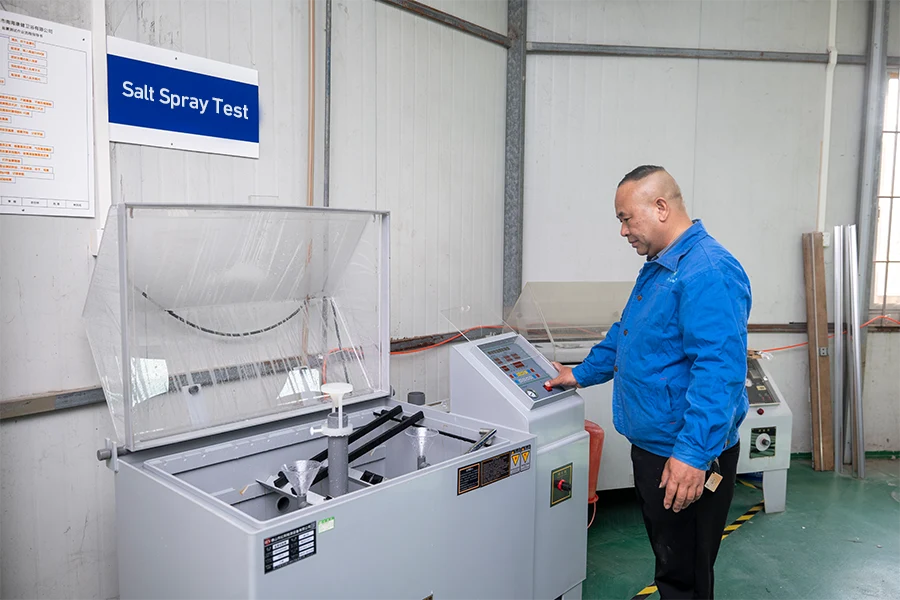
The five tests are tempering verification on glass, an impact test on the door structure, a packaging drop test, a salt spray test on hardware, and a push-pull cycle test on rollers. Hardware finishes are protected by PVD coating, and rollers are rated to 100,000 push-pull cycles, a figure that maps to roughly a decade of daily commercial use. A deeper look at each test and the reports to demand is in our article on how to ensure quality in custom shower doors.
Stage 6: Packaging and Logistics Delivery
The final stage is logistics delivery, and for glass products it deserves as much engineering as the door itself.

Packaging uses standardized honeycomb cardboard cartons with reinforced wooden framing, engineered to survive long-distance ocean freight. For e-commerce sellers, the factory provides a packaging drop-test video and report so you can verify glass will survive courier and last-mile handling. This directly protects a seller’s damage and return rate, which is why packaging is a decision-point question for online brands.

What ships with the goods matters as much as what ships in the box. A complete delivery includes a quality inspection report with tempering rate, impact, and salt spray data; SGCC and CE certificate copies that travel with the shipment for customs and site inspection; a detailed installation manual for the specific project; and a spare parts pack with rollers and seals. Certification paperwork that arrives after payment is worthless at a border, so require it in the contract.
Lead Time, MOQ, and Payment Terms
These three commercial parameters decide whether the process fits your cash flow and your project clock.
| Parameter | KJ Bath Standard | Why It Matters to You |
|---|---|---|
| Sample lead time | ~15 working days | Sets the clock for approval before production |
| First mass production | ~30 working days | Includes material scheduling for a new order |
| Repeat orders | 20-25 working days | Shorter once molds and material schedules are set |
| MOQ | 10 sets (main models) | Low enough to test a market without a full container |
| Payment terms | 30% deposit + 70% before shipment | Balance paid after pre-shipment acceptance |
| Warranty | 5 years enclosure / 3 years hardware | Backed by lifetime online technical support |
The 10-set MOQ on main models such as the JL712 and JP103 screens, the JL139 diamond unit, and the JK1934 sector unit is deliberately low. It lets a first-time importer validate a market before committing to inventory, and it lets a hotel contractor order a small pilot batch for a mock-up room before the full deployment.
Planning an OEM or ODM Shower Enclosure Program?
KJ Bath has manufactured shower enclosures since 1999 and supplies Hilton, Marriott, and Hyatt projects. Send us your drawings or a reference photo and our engineering team will return a DFM review and a value-engineering proposal, with a low 10-set MOQ and clear lead times you can build a schedule around.
Why the Process Matters More Than the Price

Two quotes for the same-looking enclosure can differ by 30% and still not be the same product. The difference lives in the process: whether the factory tempers its own glass, whether DFM catches a flaw before tooling, whether the salt spray and cycle tests are actually run, and whether certification paperwork ships with the container.
A manufacturer that controls the full supply chain, from aluminum processing to automated packaging, can hold consistency across a 1,000-set month and answer a problem in 12 hours instead of a week. That is the real product you are buying. See the whole journey on our manufacturing process page, or start a custom program through our design and prototyping team. The full range is on the shower enclosures and doors catalog.
Frequently Asked Questions
What is the difference between OEM and ODM shower enclosures?
In an OEM arrangement you supply the design, dimensions, finish, and brand, and the factory builds to your specification. In an ODM arrangement the factory has already developed the model and you license and brand it, possibly with a custom finish or dimension. OEM suits established brands that need differentiation; ODM suits sellers who want to launch fast without their own engineering team.
How long does it take to manufacture a custom shower enclosure order?
A prototype or sample takes about 15 working days. A first mass-production run takes about 30 working days including material scheduling. Repeat orders usually shorten to 20-25 working days once molds and material schedules are already in place.
What is the minimum order quantity for a custom shower enclosure?
KJ Bath sets its MOQ at 10 sets for main models such as the JL712 and JP103 screens, the JL139 diamond unit, and the JK1934 sector unit. This is low enough for a first-time importer to test a market or for a contractor to build a mock-up room before a full project deployment.
What documents should ship with an OEM shower enclosure order?
A complete delivery includes a quality inspection report with tempering, impact, and salt spray data; SGCC and CE certificate copies for customs and site inspection; a detailed installation manual for the specific project; and a spare parts pack with rollers and seals. Require the certification paperwork in the contract so it travels with the shipment rather than arriving after payment.
What are the payment terms for a custom shower enclosure order?
The standard terms are a 30% deposit with the order and the 70% balance paid before shipment, after pre-shipment acceptance passes. Custom molds are kept safely for repeat orders so precision stays consistent across production runs.