
Importing modular shower pods into the US, Canada, or EU means more than choosing a product that looks right on a spec sheet. The unit must comply with a web of building codes, plumbing standards, and safety certifications that vary by jurisdiction. A pod that ships without the right paperwork will fail inspection, sit in customs, or create liability exposure for the developer who specified it.
This guide walks through the certifications and code references that matter when you source modular shower pods for commercial projects. It covers the International Building Code (IBC), International Plumbing Code (IPC), regional variations in North America and Europe, and the documentation you should require from a manufacturer before placing an order.
Key Takeaways
- Modular shower pods sold in the US must comply with IBC Chapter 11 (accessibility) and IPC Chapter 4 (plumbing fixtures), with local amendments that vary by state and city.
- Canada references the National Plumbing Code of Canada (NPC) and provincial building codes that align with but do not identical to the IPC.
- EU member states require CE marking under the Construction Products Regulation (CPR) 305/2011, with EN 14527 for shower enclosures and EN 12056 for drainage.
- Safety glass certifications (SGCC in North America, CE EN 12150 in Europe) are non-negotiable for tempered glass panels in any shower pod.
- Importers should require test reports, not just certificates, and verify that the testing laboratory is accredited to ISO/IEC 17025.
- A manufacturer with in-house QC and ISO 9001 certification can produce the documentation package you need; a trading company that brokers orders often cannot.
Why Building Codes Matter for Modular Shower Pods
A modular shower pod is not a single product. It is an assembly of glass panels, metal framing, plumbing fittings, a base tray, and drainage components. Each of these sub-assemblies falls under a different code chapter, and the assembled unit must pass inspection as a complete system.
For importers, the risk is not just that a pod fails inspection. The risk is that a non-compliant unit creates liability for the developer, the general contractor, and the plumbing engineer who specified it. If a glass panel shatters and injures someone, and the panel was not certified to the local safety standard, the importer of record faces product liability exposure.
That is why serious buyers do not accept a certificate as a piece of paper. They require test reports from accredited laboratories, and they verify that the reports reference the exact product configuration being shipped.

North American Codes: IBC and IPC
In the United States, the International Building Code (IBC) and International Plumbing Code (IPC) are the baseline. Most states adopt them with local amendments, so a pod that complies in Texas may need additional documentation for New York or California.
IBC Chapter 11: Accessibility
IBC Chapter 11 references ICC A117.1, the standard for accessible and usable buildings. For shower pods, this means:
- Accessible units must provide a clear floor space of at least 30 inches by 48 inches outside the shower entry.
- Threshold height cannot exceed 0.5 inches for roll-in showers and 0.75 inches for other showers, with beveled edges.
- Grab bars must be mounted at 33 to 36 inches above the finished floor, with a clearance of 1.5 inches from the wall.
- Controls and faucets must be operable with one hand and without tight grasping, pinching, or twisting of the wrist.
For importers, the key is to confirm that the pod design accommodates these requirements. A manufacturer that has supplied Hilton or Marriott projects has already navigated these accessibility standards for hotel bathrooms, which are among the most stringent applications.
IPC Chapter 4: Plumbing Fixtures
IPC Chapter 4 governs the installation of plumbing fixtures, including showers. The relevant sections for modular pods are:
- Section 403: Water supply. The pod must have a dedicated shut-off valve accessible without removing finished walls.
- Section 405: Drainage. The waste outlet must be sized to handle the flow rate of the showerhead, typically 2 inches for residential and 3 inches for commercial.
- Section 406: Installation of fixtures. The pod must be anchored to the structure to prevent movement, and the base tray must be level and supported to prevent cracking.
- Section 408: Backflow protection. The shower valve must include a pressure-balancing or thermostatic mixing valve to prevent scalding.
Importers should request a plumbing rough-in diagram from the manufacturer that shows the location of supply lines, drain outlet, and shut-off valves. This diagram is what the plumbing contractor uses to prepare the site, and discrepancies between the diagram and the actual pod create installation delays.
Regional Variations: California, New York, and Beyond
California adopts the IPC with amendments in the California Plumbing Code (CPC). New York uses its own State Plumbing Code, which is based on the IPC but includes additional requirements for fire resistance and accessibility. Importers targeting multiple states should verify compliance with each jurisdiction, not just the baseline IPC.
Canadian Codes: NPC and Provincial Variations
Canada references the National Plumbing Code of Canada (NPC), which is published as Part 7 of the National Building Code of Canada (NBCC). Provinces adopt the NPC with amendments, so Ontario’s plumbing code differs in detail from British Columbia’s, though both align with the NPC framework.
The NPC requirements for shower pods are similar to the IPC:
- Water supply must be protected against backflow with a vacuum breaker or backflow preventer.
- Drainage must be sized to handle the fixture unit load, with a minimum 2-inch waste pipe for showers.
- Tempered glass must comply with CAN/CGSB-12.1, the Canadian standard for safety glazing, which is harmonized with ANSI Z97.1.
For importers, the practical difference between IPC and NPC is documentation. Canadian inspectors may require test reports that reference Canadian standards specifically, not just US equivalents. A manufacturer experienced in both markets will provide separate test reports for each.
European Standards: CE Marking and CPR
In the European Union, modular shower pods fall under the Construction Products Regulation (CPR) 305/2011. The CPR requires CE marking for any construction product placed on the EU market, and the manufacturer must issue a Declaration of Performance (DoP) that references the applicable harmonized standards.
EN 14527: Shower Enclosures
EN 14527 is the harmonized standard for shower enclosures, including prefabricated pods. It covers:
- Structural integrity: The enclosure must withstand a static load of 250 N applied to any point on the glass or framing.
- Water tightness: The enclosure must prevent water leakage at joints and seals under normal use conditions.
- Durability: Hinges, rollers, and seals must function after 20,000 cycles of opening and closing.
For importers, CE marking under EN 14527 is the baseline. Some EU member states impose additional national requirements, so the DoP should reference both the harmonized standard and any applicable national annexes.
EN 12150: Tempered Glass
EN 12150 is the European standard for thermally toughened soda lime silicate safety glass. It is the EU equivalent of SGCC in North America. Glass panels in a shower pod sold in the EU must comply with EN 12150, and the manufacturer must provide test reports showing impact resistance and fragmentation patterns.
EN 12056: Drainage
EN 12056 covers gravity drainage systems inside buildings. For shower pods, the relevant section is EN 12056-2, which specifies the sizing and installation of drainage pipes. Importers should confirm that the pod’s drainage outlet is compatible with the local drainage standards in the destination country.
Safety Glass Certifications: SGCC and CE
Regardless of the destination market, safety glass certification is non-negotiable. Tempered glass in a shower pod must be certified to the local standard, and the certification must travel with the shipment so it clears customs and passes inspection.

SGCC: North America
The Safety Glazing Certification Council (SGCC) is the recognized safety-glass listing for the US and Canadian markets. SGCC certification confirms that the glass was tested to ANSI Z97.1 (US) or CAN/CGSB-12.1 (Canada) for impact resistance. Hotel and multi-family projects typically require SGCC-certified glass with certificate copies that accompany the shipment.
CE EN 12150: Europe
In the EU, tempered glass must comply with EN 12150 and bear CE marking. The manufacturer must issue a Declaration of Performance and provide test reports from an accredited laboratory. Importers should verify that the testing laboratory is accredited to ISO/IEC 17025, the international standard for testing and calibration laboratories.
What to Require from Manufacturers
Importers should not accept a certificate as a standalone document. A certificate says the product passed a test; a test report shows what was tested, how it was tested, and what the results were. For code compliance, you need the test report, not just the certificate.
The documentation package you should require from a modular shower pod manufacturer includes:
- Test reports for safety glass (SGCC or EN 12150) from an ISO/IEC 17025 accredited laboratory.
- Test reports for the assembled enclosure (EN 14527 for EU, or equivalent for North America) showing structural integrity, water tightness, and durability.
- Plumbing rough-in diagrams showing supply line locations, drain outlet size, and shut-off valve access.
- Declaration of Performance (DoP) for CE-marked products, referencing the applicable harmonized standards.
- ISO 9001 certificate for the manufacturer’s quality management system.
- Product warranty terms, specifying coverage for glass, hardware, and base tray.
A manufacturer with in-house QC and ISO 9001 certification can produce this documentation package. A trading company that brokers orders from multiple factories often cannot, because it does not control the testing process or have direct access to the test reports.

Need a Modular Shower Pod Supplier Who Understands Code Compliance?
KJ Bath has supplied Hilton, Marriott, and Hyatt projects with modular shower pods that meet IBC, IPC, and CE requirements. We provide a complete documentation package with every shipment, including test reports, plumbing diagrams, and Declaration of Performance. Send us your project specs and we will confirm compliance before you place an order.
Why Choose KJ Bath
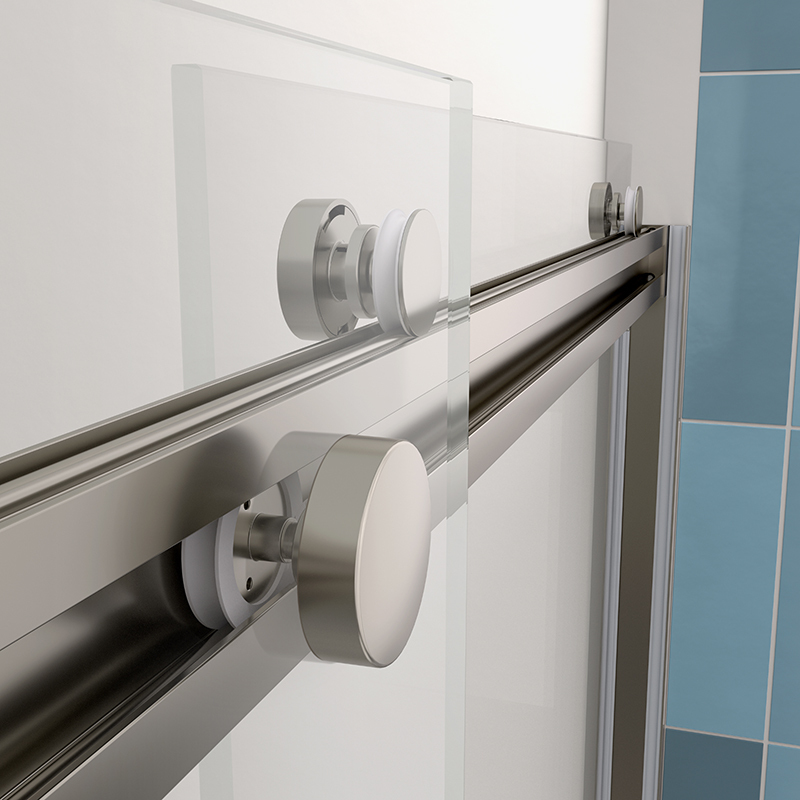
KJ Bath (Foshan Nanhai Kangjian Sanitaryware) has manufactured shower enclosures and modular pods since 1999. The 15,000 sqm factory runs four dedicated workshops with 151 staff and a 12-person R&D team. All glass is tempered from 6mm to 12mm using Xinyi original sheets and passes five QC tests: tempering verification, impact, packaging drop, salt spray, and push-pull cycle. The company holds ISO 9001, ISO 14001, ISO 45001, SGCC, and CE certifications and has supplied Hilton, Marriott, and Hyatt projects worldwide. MOQ is 10 sets, samples take 15 days, production 30 days, all backed by a 5-year enclosure warranty and a 3-year hardware warranty. Learn more about KJ Bath.
Frequently Asked Questions
What certifications do modular shower pods need for the US market?
Modular shower pods sold in the US must comply with the International Building Code (IBC) for accessibility and the International Plumbing Code (IPC) for plumbing fixtures. Tempered glass must be certified to ANSI Z97.1 through the Safety Glazing Certification Council (SGCC). Some states like California and New York have additional amendments that must be verified separately.
Is CE marking required for shower pods sold in Europe?
Yes. Under the Construction Products Regulation (CPR) 305/2011, any shower pod placed on the EU market must bear CE marking. The manufacturer must issue a Declaration of Performance referencing EN 14527 for shower enclosures and EN 12150 for tempered glass. The testing laboratory must be accredited to ISO/IEC 17025.
What is the difference between a certificate and a test report?
A certificate states that a product passed a test. A test report shows what was tested, the test method, the results, and the name of the accredited laboratory that performed the test. For code compliance, importers need the test report, not just the certificate, because inspectors and engineers need to verify that the test covered the exact product configuration being shipped.
Do Canadian projects require different certifications than US projects?
Canada references the National Plumbing Code of Canada (NPC) and CAN/CGSB-12.1 for safety glass, which is harmonized with ANSI Z97.1. The technical requirements are similar to the US, but Canadian inspectors may require test reports that reference Canadian standards specifically. A manufacturer experienced in both markets will provide separate documentation for each.
Can a trading company provide the certifications I need?
A trading company that brokers orders from multiple factories often cannot provide complete test reports, because it does not control the testing process or have direct access to the laboratory results. For code compliance, importers should work with a manufacturer that has in-house QC, ISO 9001 certification, and direct relationships with accredited testing laboratories.