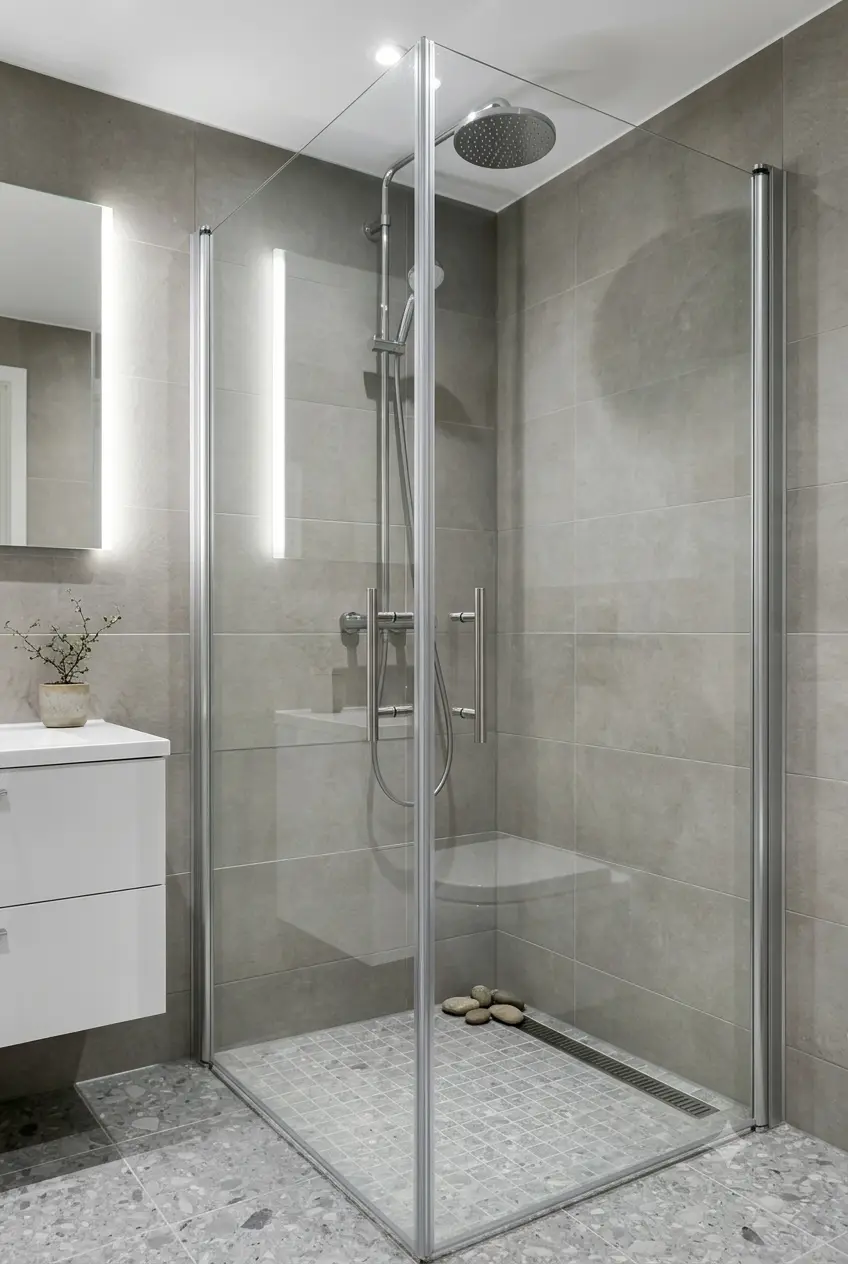
A frameless sliding door looks like the simplest thing in the bathroom to specify: two sheets of glass on a rail. Then the spec sheet arrives, and it says “10mm tempered, stainless hardware, powder coat” — which is enough to price a unit and not enough to predict whether it will still roll quietly in year seven, or whether the head track will hold a 1600mm span without a middle post.
This article sets out the specification fields that actually decide performance for a frameless slider, and what evidence should stand behind each one: glass thickness against panel width and height, the SGCC and ANSI Z97.1 paperwork, head track span and wall channel, roller loading and its cycle rating, seals and water management, and the packaging data that determines whether the panels arrive intact. Where KJ Bath figures are quoted, they come from our own test reports and production standards, so you can use them as a benchmark when you read somebody else’s sheet.
Key Takeaways
- In a frameless slider the glass is the structure, so thickness is set by panel width and height, not by appearance: 10mm is the working minimum, 12mm for wide or tall leaves.
- The head track carries a suspended load across a span. Ask what stops mid-span sag and how the track is supported at each end.
- Roller load per wheel, bearing type, and a documented cycle rating are three separate questions; a “heavy duty” adjective answers none of them.
- Water containment in a frameless slider comes from seal geometry, floor fall and curb height — the glass cannot compensate for a missing slope.
- Certification is market-specific: SGCC listing built on ANSI Z97.1 for North America, CE documentation for the EU. Certificates must travel with the shipment.
- Ask for five test records before ordering: tempering and impact, roller cycle, salt spray on the finish, packaging drop, and a dimensional check against your drawings.
What a Real Specification Sheet Says
A usable spec sheet for a frameless slider answers, line by line: panel count and travel direction; finished opening width and height; clear opening per pass; glass thickness, grade, colour and coating; certification body and certificate number; head track profile, alloy, wall thickness and maximum supported span; roller material, bearing type, load rating and cycle rating; seal set part numbers; finish and its corrosion evidence; per-set packed dimensions and weight; MOQ, sample and production lead times; and the warranty split between enclosure and hardware.
If a sheet cannot answer the span, load and cycle lines, the supplier has quoted an appearance rather than a structure.

New to the vocabulary? The enclosure terminology glossary defines the hardware and commercial terms used here, and what is a sliding shower door explains the mechanism from first principles.
Glass: Thickness, Size, and the Certification Behind It
Frameless construction removes the metal that would otherwise stiffen a panel, so the glass carries the rigidity. Commercial enclosures use tempered safety glass from 6mm to 12mm; within a frame, 6-8mm is normal. Frameless is a different calculation:
- 10mm is the working minimum for a frameless leaf, and is comfortable for typical single-panel widths up to roughly a metre.
- 12mm belongs on wider or taller leaves, where wind-of-the-door loads from daily pulling and the panel’s own height start to produce visible flex.
- Height matters as much as width. A tall leaf on a short track section behaves differently from a wide leaf on a long one; check both dimensions against the supplier’s own thickness table rather than a rule of thumb.
Flex is not only a feel problem. Every cycle of a flexing panel loads the roller bearings and works the seal line, and it is how edge chips start. Where a project needs a taller or wider leaf than the thickness table supports, the answers are a thicker panel, a supporting fixed panel, or a different configuration — not the same 10mm glass with a prayer.
Certification and glass origin
For North American work, require SGCC listing built on the ANSI Z97.1 impact performance standard, with certificate copies that travel with the shipment so the load clears customs and passes site inspection. The EU route is CE documentation. Our SGCC vs CE vs ANSI Z97.1 comparison sets out which document each market asks for. KJ Bath tempers in-house from Xinyi original sheets, which means the glass batch and its test record can be traced back to a single production step rather than a trading company’s invoice.
Coatings and tints
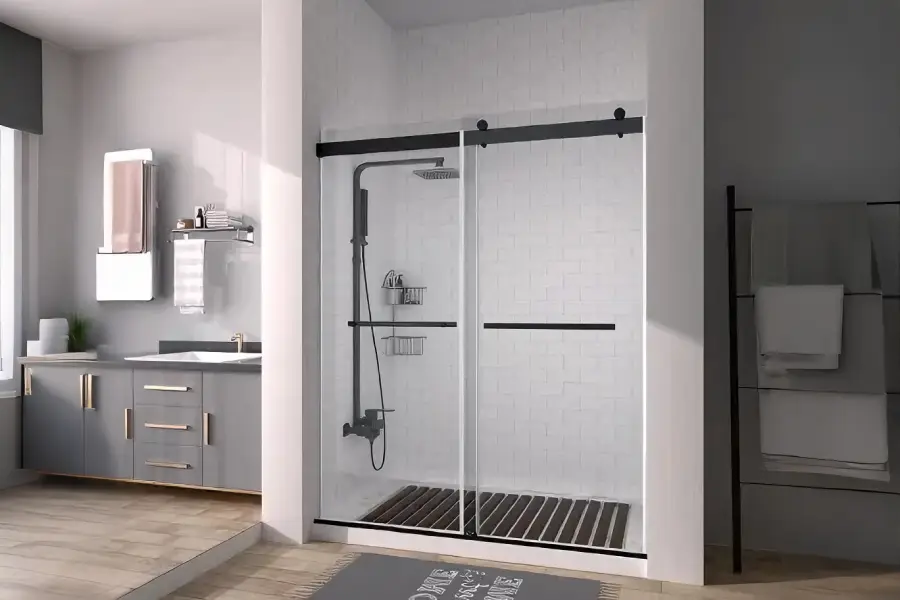
An easy-clean coating reduces how often a panel needs scrubbing in hard-water markets and is worth specifying on rooms that see daily use. Glass colour — clear, low-iron, rain pattern, frosted — changes light and privacy, and low-iron commands a premium on luxury guest bathrooms; the visual trade-offs are compared in rain glass versus clear glass and low-iron versus clear glass.
Track Load: The Number Nobody Writes Down
A 12mm frameless panel one metre wide and two metres tall is roughly 28kg of glass; a pair of them is over 50kg riding on a aluminium channel and a handful of wheels, for years, several times a day, by people who do not treat doors gently. Track load is therefore the specification line most likely to be missing and most likely to matter.
What to pin down
- Alloy and wall thickness. Structural aluminium profile with an adequate wall, not a decorative trim section.
- Maximum unsupported span. Ask at what width the manufacturer requires a middle support or a taller header, and compare that with your drawing.
- End support condition. The head track must land on solid blocking or a structure that can take the hung load; on a light partition, the fixing detail is the project risk, not the glass.
- Adjustment range. Wall channels absorb a limited amount of out-of-plumb. Confirm the range and check it against the surveyed tolerance.
KJ Bath’s engineering team reviews drawings before production on project orders, and structural pre-check on a track span and its fixings is exactly what that review is for. Where a span will not work, the fix is cheap on paper and expensive on site.
Rollers and Wheels: Load, Bearing, and the Cycle Test

Three separate questions decide roller life, and a supplier’s brochure usually collapses them into one:
- Material and corrosion resistance. Grade 304 stainless wheels resist hotel humidity and cleaning chemistry; plated zinc does not, and a corroded bearing seizes before the wheel wears out.
- Bearing type and sealing. A sealed bearing keeps limescale dust out of the race. An open bearing in a hard-water bathroom has a predictable service life measured in months, not years.
- Load per wheel and wheel count. Divide the panel weight by the number of loaded wheels and compare against the rated load. Two wheels carrying 28kg each is a different proposition from four.
The cycle rating and what it means
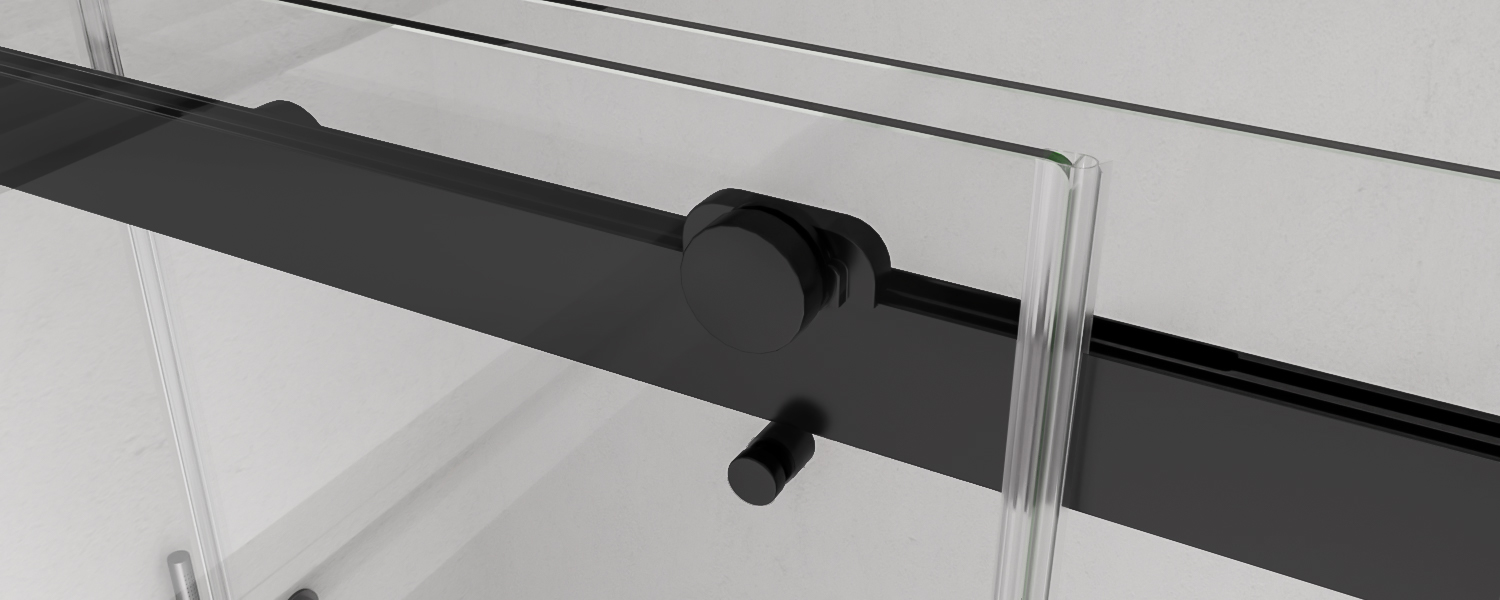
KJ Bath tests sliding hardware to 100,000 push-pull cycles on a dedicated rig. Read that number for what it is: at, say, five operations a day in a hotel room, 100,000 cycles is decades of single-room use, which is why the figure maps comfortably onto a full service life before moving hardware needs attention in a building where rooms are occupied most nights of the year. It is a durability comparison tool between suppliers, not a warranty period, and it is worthless without the test record behind it. Ask three questions and expect three answers: what cycle count, on what load, with what report?

The maintenance consequences of skipping this step are covered in hotel shower screen maintenance and in our guide to shower door replacement tips.
Finish: Coating Process and Corrosion Evidence
Matte black, brushed gold and gunmetal finishes on a slider sit in the worst environment in the building: constant moisture, heat, and aggressive cleaners. Two process questions decide whether the colour survives:
- PVD or powder coat, not plating. PVD bonds a hard, corrosion-resistant layer in a vacuum and holds colour far better than standard electroplating under repeated cleaning. Powder coating on aluminium profile is the durable route for track and housing parts.
- Salt spray hours, on the actual part. KJ Bath runs a 72-hour salt-spray test on hardware before approving a finish for production, and treats the track housing and the bottom guide as parts to test, not cosmetic afterthoughts that get skipped because nobody photographs them.

A finish claim without a corrosion report is a photograph, not a specification.
Seals, Water Management, and the Tolerance Bill
A frameless slider contains water with geometry rather than a channel around every edge, so three details decide whether the floor outside the enclosure stays dry:
- Seal set. Interlocking strips at the panel overlap, a threshold deflector, and wall bulbs where the fixed panels meet the tile. Specify them as numbered parts, because they are the first consumable in the maintenance budget. Magnetic strips that pull overlapping panels together are a small, cheap item whose failure is instantly visible as a wet floor.
- Fall and curb. The floor must slope towards the drain and the curb height must match the track housing. On a renovation tiling over an existing floor, finished floor level and build-up have to be measured before the door type is chosen.
- Tolerance absorption. Frameless hardware shows wall deviation instead of hiding it. Confirm the adjustment range of the wall channel and check it against a survey of the actual rooms — the worst corner in the building, not the best.
Documentation: the Five Reports to Require
Put these in the purchase order and a goods-in inspection becomes possible rather than aspirational:
- Tempering and impact verification on the shipped batch, with the SGCC or CE documentation that matches the market.
- Roller cycle test report stating cycle count, applied load, and rig standard.
- Salt-spray report naming the tested parts, the hours, and the result.
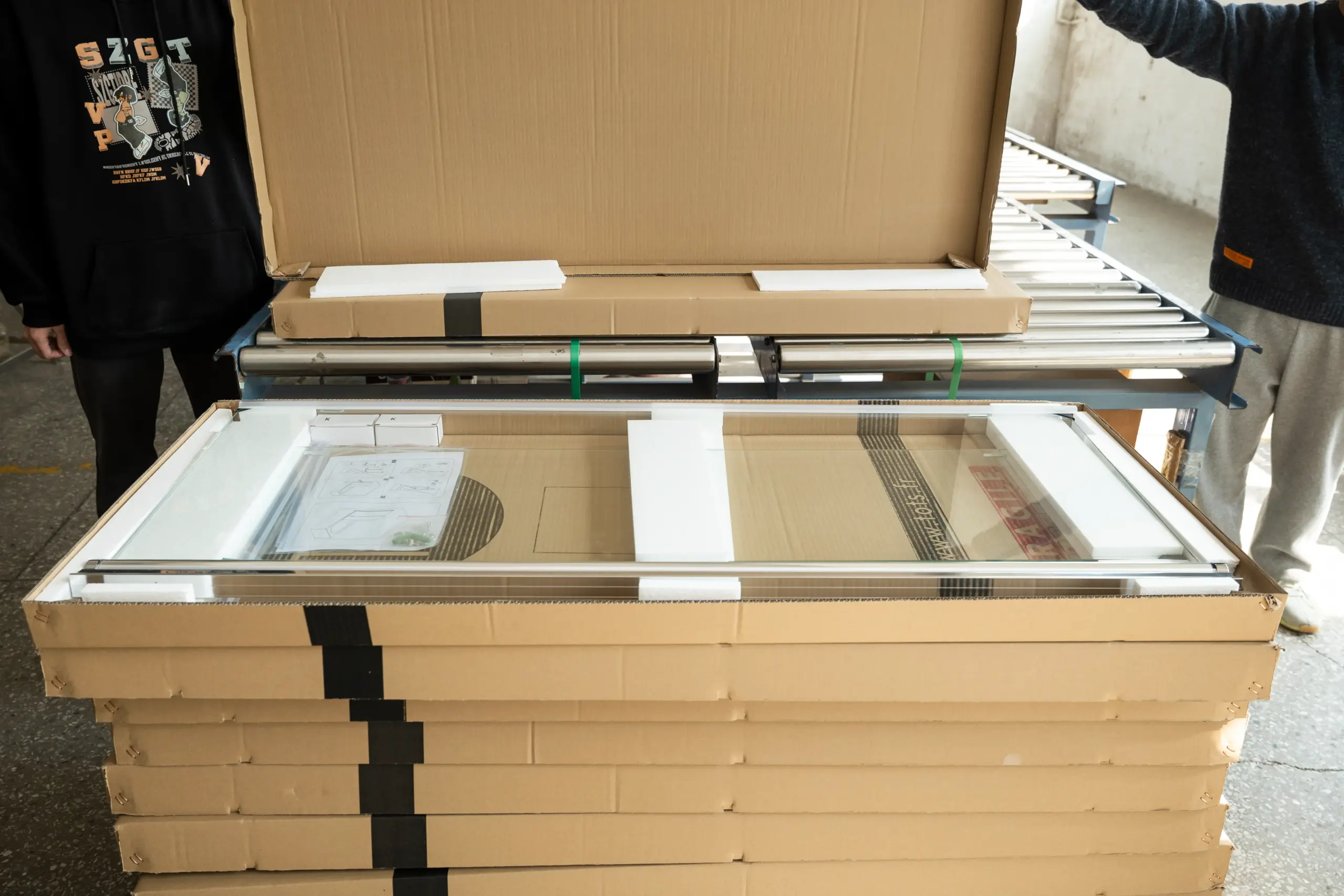
- Packaging drop test evidence, ideally video, against the courier regime the goods will actually face.
- Dimensional check against your drawings, signed before packing, since a 5mm error discovered on site is a re-manufacture and a delay.
KJ Bath ships a quality inspection report covering tempering, impact and salt-spray data, SGCC/CE certificate copies, an installation manual for the specific project configuration, and a spare-parts pack with wear rollers and seal sets. Our guide to reading a factory audit report explains what each document should contain, and the quality tests guide covers what to verify at goods-in.
How to Read a Competing Quote in Five Minutes
Take two quotations, put them side by side, and check for five things. Thickness stated per panel rather than “as required”. Track span limit declared, or absent. Roller material and bearing type named, with a cycle count and a report reference. Corrosion hours quoted for the finish, including the track. Seal and roller part numbers with a spares ratio. A quotation that clears all five can be compared on price. One that fails them is not cheaper — it is unpriced risk transferred to you.
Verifying a Frameless Slider Specification?
Send KJ Bath the spec sheet or drawing you are working from. We will mark the load, span, glass and seal lines that decide service life, and return the matching test reports — cycle, salt spray, tempering and impact — before you commit to an order.
Why Choose KJ Bath

KJ Bath (Foshan Nanhai Kangjian Sanitaryware) has manufactured shower enclosures since 1999. The 15,000 sqm factory runs four dedicated workshops — aluminium processing, glass cutting and tempering, assembly, and automated packaging — with 151 staff, a 12-person R&D team, and monthly output of 1,000 sets. Frameless sliding ranges are built in 6-12mm tempered glass from Xinyi original sheets, with hardware rated to 100,000 push-pull cycles, finishes verified by 72-hour salt spray, and five QC tests run on every order: tempering verification, impact, packaging drop, salt spray, and push-pull cycle. The company holds ISO 9001, ISO 14001, ISO 45001, SGCC and CE certification and has supplied Hilton, Marriott and Hyatt projects. MOQ is 10 sets, samples take 15 working days, first production runs 30 days and repeat orders 20-25, backed by a 5-year enclosure warranty and a 3-year hardware warranty. See the frameless sliding range or more about the factory.
Frequently Asked Questions
How thick should glass be for a frameless sliding shower door?
10mm tempered is the working minimum for a frameless leaf, because the glass itself provides the rigidity that a frame would otherwise supply. Move to 12mm for wider or taller panels, where the panel’s own height amplifies the loads applied during daily use. Framed and semi-frameless units can run 6-8mm because the metal channel stiffens them. Judge thickness against both width and height on your drawing, not against a single rule.
What does a 100,000-cycle roller test actually tell a buyer?
It is a comparison tool: the count of push-pull operations a hardware set survived on a rig, which lets you rank two suppliers’ sliding systems on the same basis. It only means something when the report also states the applied load and the test standard, because a cycle rating achieved with a light test load is not equivalent to one achieved under full panel weight. Treat a cycle figure without a report reference as unproven.
How do I check a sliding door specification sheet is complete?
Look for six lines that a decorative quote usually omits: glass thickness per panel with certification body and number, head track profile with its maximum supported span and end-fixing requirement, roller material, bearing sealing and load rating, finish process with salt-spray hours, numbered seal and roller spare parts, and per-set packed dimensions and weight. If those are present, quotations from different factories can be compared on price; if not, they are not comparable at all.
Does a frameless sliding door leak more than a framed one?
It contains water differently. A framed unit surrounds every edge in a channel and is the strongest containment option, which is why gyms and locker rooms use it. A frameless slider relies on interlocking seals at the overlap, a threshold deflector, and a correctly sloped floor with a matching curb height. With the right fall and a proper seal set it performs well; without them no door type will keep the floor dry, so treat floor preparation as part of the enclosure specification.
Which certification do I need for shower glass in North America?
SGCC listing, which is built on the ANSI Z97.1 performance standard for safety glazing in doors and shower enclosures. Hotel and multi-family projects commonly require it, and the certificate copies should travel with the shipment so the goods clear customs and pass site inspection. European projects work to CE documentation instead. Our comparison of SGCC, CE and ANSI Z97.1 explains which document each market asks for and how to verify it.
Can a frameless sliding door be made to a custom size?
Yes, within the limits of the track system and the thickness table, which is why the span and fixing checks belong before the size decision rather than after it. Custom sizes normally start at a 10-set minimum order, with samples in about 15 working days and first production runs around 30 days, so a pilot set per configuration is affordable. Ask the factory to review your drawings for structural feasibility before tooling; on a project order, that pre-check is where avoidable cost is removed.