Ask three factories for a “раздвижная дверь в душ” and you will get three different products back. One quotes a two-panel bypass, another a coplanar inline unit, a third a four-panel double slider. All three answers are correct, потому что “скольжение” describes the motion, not the mechanism. For a specifier or procurement lead that ambiguity is expensive: the configuration decides clear opening width, how many panels carry the load, what the track has to survive, and what your housekeeping team can actually clean.
This guide separates the three families that show up most often in B2B quotations — bypass, в соответствии, and double sliding — and walks through the specification consequences of each: panel count and overlap, track layout, glass thickness against panel width, roller loading and cycle testing, уплотнение, and service parts. The goal is that your next request for quotation names one configuration precisely, and every supplier prices the same thing.
Ключевые выводы
- Обход, в соответствии, and double sliding differ mainly in how many tracks the panels run on and how much of the opening a single pass exposes.
- A two-panel bypass opens roughly half its span; a double slider opens up to two halves at once; an inline unit trades opening width for a shallower, cleaner threshold.
- Panel count is a load calculation, not a look. Every extra leaf adds weight to the head track and another set of rollers to stock.
- Glass thickness should be set by panel width and frame style: 6-8mm inside a frame, 10mm as the working minimum frameless, 12mm for wide or tall frameless leaves.
- Ask for the same three documents for any configuration: SGCC/ANSI Z97.1 glass certification, a roller cycle-test report, and a salt-spray report on the finish.
- Standardising one configuration across room types cuts spares, обучение, and installation errors, which is where the real multi-year saving sits.
What Actually Differs Between the Three Families
Every sliding enclosure answers the same three mechanical questions, and the answers are what separate the categories:
- How many track lines? Bypass units run panels on two or more parallel lines so the leaves pass each other. Inline units run every leaf in one coplanar channel, so they never overlap.
- How much opening per pass? Overlapping panels give you roughly half the span with two leaves; more leaves and centre-parting give you a wider gap without widening the enclosure.
- Where does the weight go? Top-hung systems carry the glass on the head track and guide at the threshold; the head track and its rollers become the lifetime-critical parts.

If the vocabulary is new to you, наш Словарь терминов для душевых кабин defines the hardware and commercial terms used below, и что такое раздвижная дверь для душа covers the mechanism from first principles.
Bypass Sliding Doors: Two Panels Passing on Parallel Tracks
A bypass enclosure has two (occasionally three) leaves on separate, parallel track lines, so one panel slides past the other instead of folding or stacking. It is the default configuration for a tub alcove and for the straight-run ensuites that repeat down a hotel corridor.
Where bypass earns its place
Panels are large, hardware is simple, and nothing projects into the room. Two leaves on a 1200-1500mm span give a clear opening of about half the width, which is sufficient for a standing adult and for most housekeeping routines. Because each leaf rides its own channel, a bypass unit tolerates a slightly wider range of wall conditions than a coplanar inline system — the frame or the track housing absorbs what the substrate cannot.
Where it costs you
The parallel tracks mean a deeper threshold housing and a double channel that collects water and limescale, so cleaning access to the far track should be designed in, not discovered later. The overlap also means the effective opening is smaller than the nominal door width once you subtract the post and the leaf that stays fixed. Наш гид по sliding shower doors for compact commercial bathrooms works through the clear-opening maths room by room.
Inline Sliding Doors: Coplanar Panels in One Channel
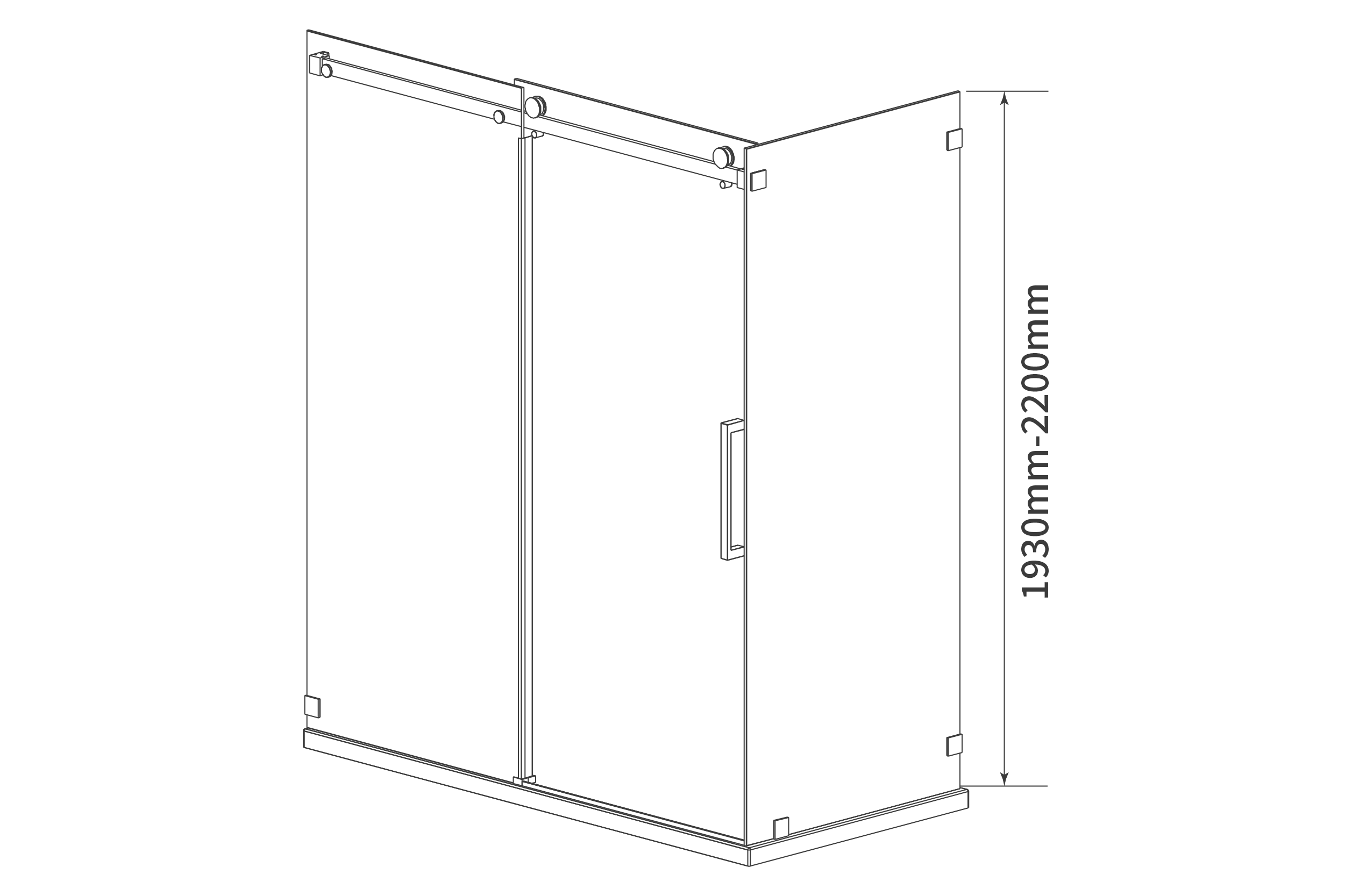
“В соответствии” is used in two closely related ways in this category, and you should confirm which one a supplier means before you sign a spec sheet. The first is a straight, single-line run as opposed to a corner or curved unit — panels travel in one plane along one wall. The second is a stacker, where every leaf hangs in the same plane and collects at one end, so a three- or four-panel inline unit can expose nearly the full span.
The trade
A single-plane run gives a cleaner sightline and a shallow threshold, which helps with drainage detail and with accessibility where a low curb matters. The price is precision: coplanar panels need a straight, level, plumb line of wall, and tile buildup on a renovation has nowhere to hide. Stackers need pocket space at one end for the collected leaves — measure it, because a stacker that cannot stack is just an expensive fixed screen.
Double Sliding and Centre-Parting Units
A double sliding (dual-slide) enclosure moves two leaves from the centre outwards, or runs four panels as two bypass pairs. You get a wide, symmetrical opening from a fixed overall width, which is why the format appears on long tub runs, wet-area divisions, and lobbies where two people need to enter or exit without queueing.
The cost sits in hardware, not glass. Two moving leaves double the roller count, double the number of wear parts in the head track, and put the full weight of both panels across a longer unsupported span. If you specify a dual-slide unit, specify the head track profile and the roller rating in the same paragraph. А single-slide versus dual-slide comparison covers the C-side version of this choice; the procurement consequence is that a dual-slide quotation should never be cheaper per metre than a single-slide of the same build, and if it is, something has been removed from the track.
The Three Configurations Side by Side
| Specification point | Обход (2 панели) | В соответствии / stacker | Двойной раздвижной |
|---|---|---|---|
| Track lines | Two parallel channels | One coplanar channel | Two channels, leaves from the centre |
| Clear opening per pass | About half the span | Up to most of the span once stacked | Two quarter-spans meeting in the middle |
| Moving panels to maintain | 1-2 | 2-4, all in one plane | 2 (4 on large units) |
| Substrate tolerance | Хороший; housing absorbs small deviation | Низкий; needs a straight, level, plumb run | Умеренный; span and level both matter |
| Порог / уборка | Deeper double channel, more trap points | Shallow guide, easier squeegee pass | Centre junction is the leak and grit point |
| Typical commercial home | Tub alcoves, repeating ensuite stacks | Design-led rooms, wet areas, low curbs | Long runs, high-traffic entry, доступность |
Толщина стекла, Panel Width, and What the Track Carries
Configuration decides the load; glass and frame style decide whether the structure carries it. Commercial shower glass is tempered safety glass in the 6-12mm range, and the sensible way to read that range is as a function of panel size and support:
- 6-8мм inside a framed or semi-frameless system, where the metal channel does the stiffening. This is the volume specification for mid-scale hotel and locker-room work.
- 10мм as the working minimum for a frameless leaf, where the panel itself provides rigidity.
- 12мм for wide or tall frameless panels, and wherever the leaf spans beyond what 10mm can hold without flex under repeated use.
Whatever the thickness, the panels should be tempered from verified original sheets and certified to the safety-glazing requirements of the destination market. In North America that means SGCC listing built on the ANSI Z97.1 impact performance standard; our comparison of SGCC, CE and ANSI Z97.1 explains which document a inspector asks for. KJ Bath’s glass workshop tempers in-house from Xinyi original sheets and runs a five-test QC sequence — tempering verification, влияние, падение упаковки, соляной туман, and push-pull cycle — with the reports travelling with the shipment.
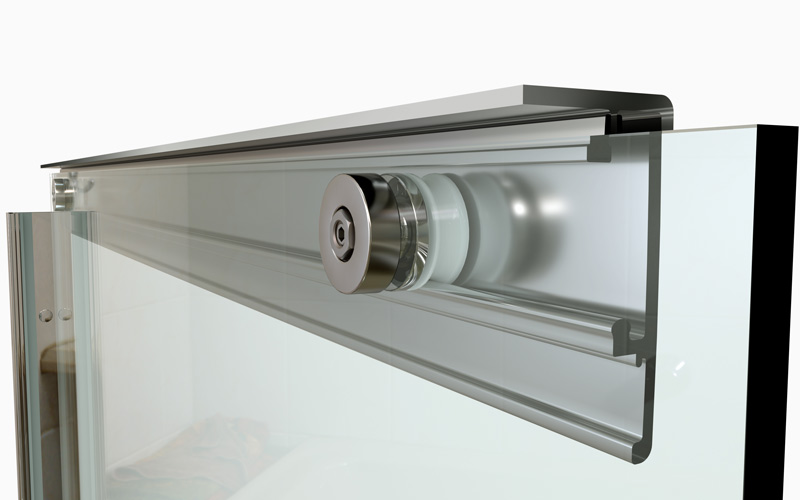
Ролики, Треки, and the Cycle Test That Backs Them
A bypass or dual-slide door spends its life hanging from two or four contact points. Three hardware decisions decide whether it is still smooth in year eight:
Roller material and bearing
Stainless steel wheels with a properly sealed bearing resist the moisture and cleaning chemistry of a commercial bathroom far better than plated zinc. Ask what grade, and ask whether the bearing is sealed or open; an open bearing in a limescale-heavy environment is a maintenance ticket waiting to be raised.
Cycle rating, evidenced
Durability claims are only useful with a test report behind them. KJ Bath оценивает свою раздвижную фурнитуру как 100,000 push-pull cycles on a dedicated cycle-test rig, which maps to roughly a decade of daily use in a hotel room before the moving parts need attention. Treat a supplier’s cycle figure as unproven until you see the rig result, the same way you would treat a corrosion claim without a salt-spray report.
Track profile and serviceability
The head track carries the load; the bottom guide only stops the panel wandering. Confirm the leaf can be lifted out of the track in place, because a slider that cannot be removed cannot be cleaned properly or swapped without a contractor. Наша разбивка the quality tests a shower enclosure should pass lists what to ask for at goods-in.
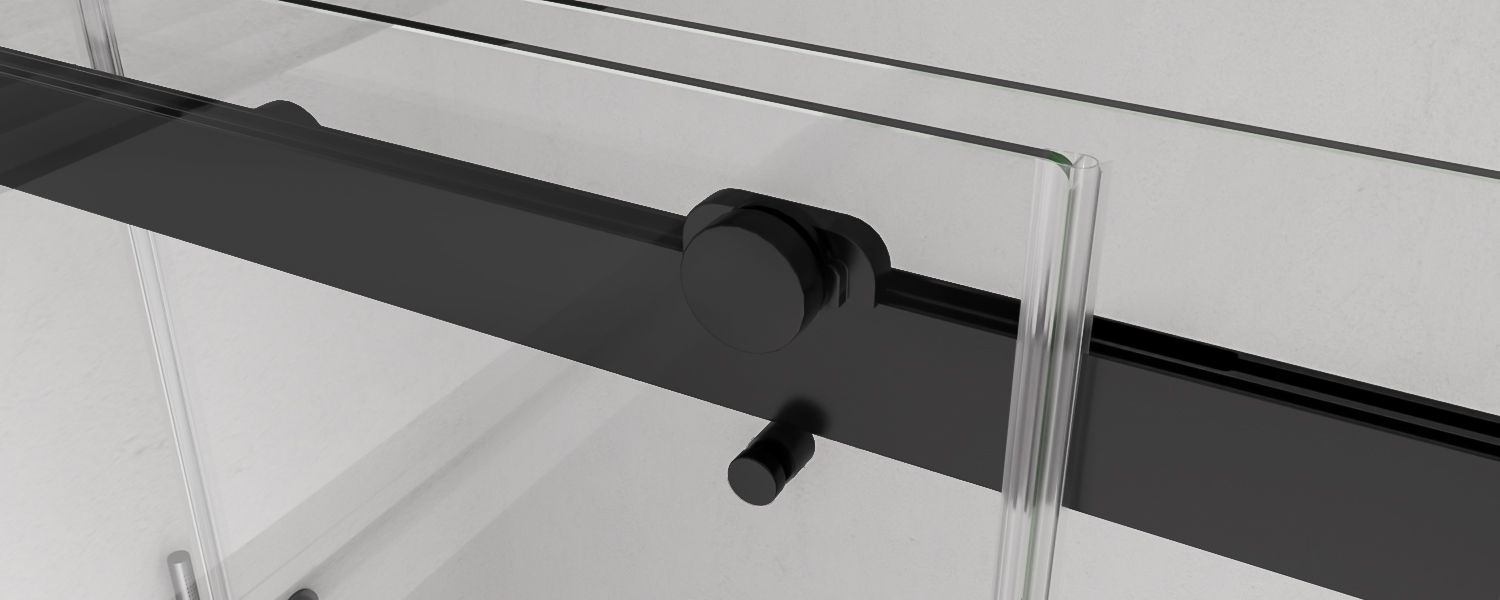
Заканчивать, Sealing and Ventilation
Finish is a durability decision disguised as an aesthetic one. PVD coating bonds a hard, corrosion-resistant layer onto hardware in a vacuum process and holds colour far better than standard electroplating under daily cleaning; salt-spray testing is how you verify the claim. KJ Bath runs a 72-hour salt-spray test on hardware before a finish is approved for production.
Sealing follows the geometry. Bypass units rely on interlocking pile or magnetic strips at the overlap plus a threshold deflector; inline units need a continuous bottom guide; dual-slide units have a centre junction that is simultaneously the weakest water point and the grit collector. Ask for the seal set as a line item with a part number, because seals are the first consumable your maintenance budget will carry. Panels can also be specified with an easy-clean coating, which reduces the limescale scrub cycle in hard-water markets.
How to Quote the Three Configurations Without Ambiguity
Put these ten fields in the request for quotation and the bids become comparable:
- Configuration named explicitly: обойти / inline stacker / dual-slide, with the plan drawing attached.
- Finished width and height at each opening, plus finished floor level and threshold height allowance.
- Glass thickness per leaf, стиль рамки, and whether panels are tempered to SGCC/ANSI Z97.1 with certificates supplied.
- Clear opening required per pass, stated as a number, not implied by panel count.
- Track material and profile, roller grade and bearing type, cycle-test report reference.
- Finish and its process (ПВД, порошковое покрытие, plating) with salt-spray hours.
- Seal set part numbers and the spares ratio per 100 комнаты.
- Mounting condition: new build or over-tile, and who sets the out-of-plumb tolerance.
- Могил, время выполнения образца, production lead time, and packed dimensions per set for your container maths.
- Warranty terms split between enclosure and hardware, since they rarely match.
Standardise on one configuration wherever the room geometry allows. Repeating a single track system across a room stack means one spares list, one training session for installers, and one failure mode to learn instead of three.
Specifying a Configuration and Wanting All Bids on the Same Basis?
Send KJ Bath your room schedule and drawings. We will return bypass, в соответствии, and dual-slide options with glass, отслеживать, roller and seal details priced on the same basis, plus a structural pre-check on the drawings before anything is tooled.
Почему стоит выбрать KJ Bath

Кей Джей Бат (Фошань Наньхай Канцзян Сантехника) производит душевые кабины с тех пор 1999. А 15,000 м² на заводе работают четыре специализированных цеха — обработка алюминия, резка и закалка стекла, сборка, и автоматизированная упаковка — с 151 персонал, R на 12 человек&команда Д, и ежемесячный выпуск 1,000 наборы. Sliding ranges cover bypass, inline and dual-slide formats in 6-12mm tempered glass with PVD and powder-coated finishes, ролики рассчитаны на 100,000 cycles and hardware verified by 72-hour salt spray. Компания имеет сертификат ISO 9001, ИСО 14001, ИСО 45001, сертифицированы SGCC и CE и предоставили Hilton, Проекты Marriott и Hyatt. минимальный заказ 10 наборы, образцы берут 15 рабочие дни, первые производственные циклы 30 дни, предоставляется 5-летняя гарантия на корпус и 3-летняя гарантия на оборудование.. More about KJ Bath, или просмотрите диапазон раздвижных душевых дверей.
Часто задаваемые вопросы
What is the difference between a bypass and an inline sliding shower door?
A bypass door runs its panels on two parallel track lines so the leaves pass each other, giving about half the span as clear opening from two panels. An inline door keeps every leaf in one coplanar channel, so panels stack at one end instead of overlapping. The inline route gives a shallower threshold and a cleaner sightline but demands a straighter, leveler wall; bypass is more forgiving of substrate and easier to source at volume.
How much glass thickness does a double sliding shower door need?
Thickness follows panel width and frame style rather than the number of panels. Framed and semi-frameless leaves work at 6-8mm because the channel stiffens them. Frameless leaves need 10mm as a working minimum, moving to 12mm for wide or tall panels. A dual-slide unit does not need thicker glass than a single-slide of the same leaf size, but it does need a stronger head track and more rollers, since two leaves now hang in the same span.
Which configuration is easiest to maintain in a hotel?
The one that repeats. A single bypass specification installed across every identical room means one spares list and one cleaning routine, which usually beats any structural advantage elsewhere. Between configurations, an inline unit with a shallow guide is faster to squeegee, while a bypass double channel traps more scale and needs the far track reachable. In both cases the panel must lift out of the track in place, or cleaning and replacement both become a contractor job.
Do more panels mean a wider opening?
Not automatically. Two panels on a bypass track expose roughly half the span whatever their size. Three or four panels in an inline stack, or a centre-parting dual slide, expose more of the span from the same overall width. The limit is pocket space: stacked leaves have to collect somewhere, and a centre-parting unit needs the hardware at both ends. Ask for the clear opening dimension on the drawing and ignore the panel count.
What documents should a supplier provide for a sliding configuration?
Three sets, как минимум: сертификация стекла для целевого рынка (SGCC listing with ANSI Z97.1 test evidence for North America, Документация CE для ЕС), a roller cycle-test report supporting the durability claim, and a salt-spray report for the specified finish. Add the packed dimensions and a part-numbered seal and roller set so landed-cost and maintenance planning are based on facts rather than estimates.
Can one project mix bypass, inline and dual-slide units?
Да, and most hotel and apartment schemes do — suites, accessible rooms and tub alcoves rarely share one geometry. The discipline is to limit the mix to two configurations across the building and to keep the track system, finish and roller family identical wherever possible, so installers learn one system and housekeeping stocks one set of wear parts. Наш Руководство по спецификации вольеров для отелей covers scheduling by room type.