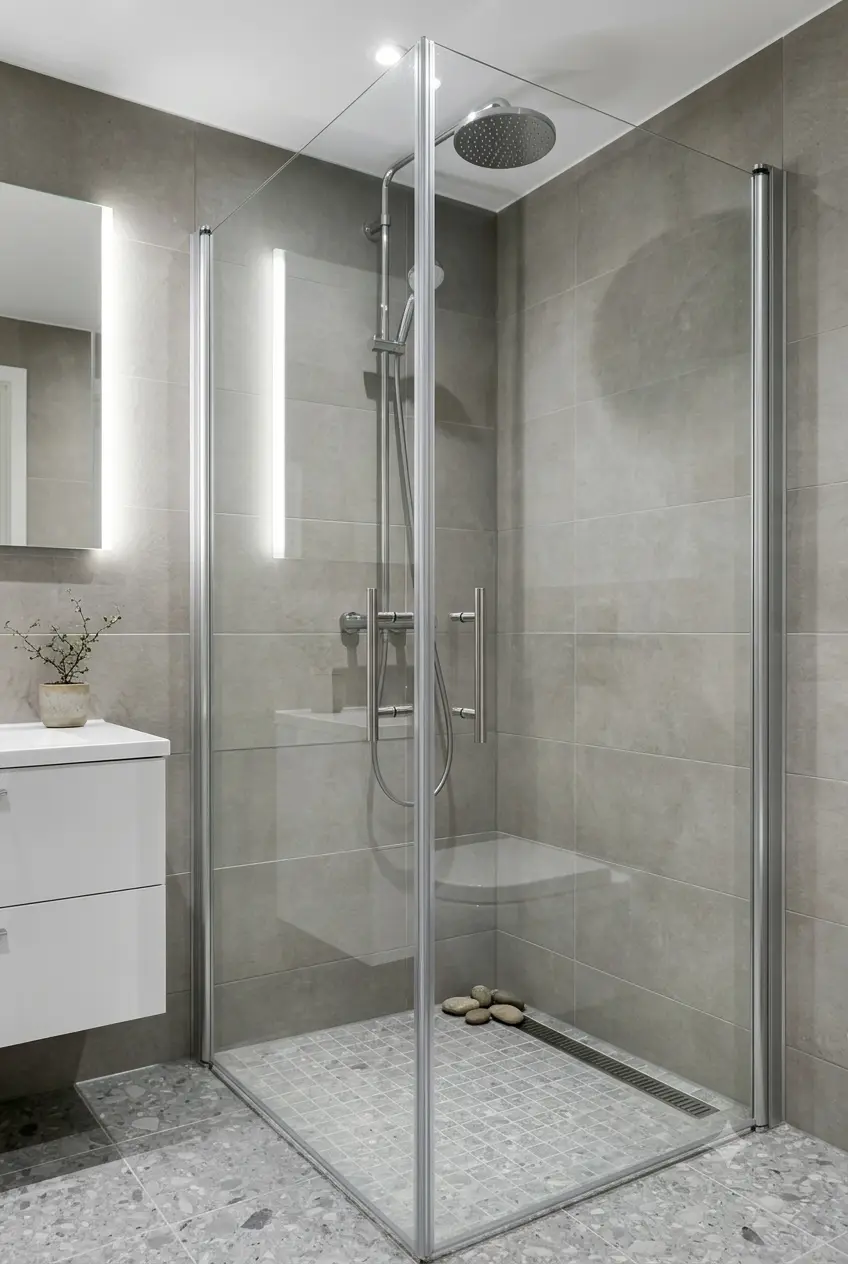
Door type is where a small commercial bathroom either works or wastes its floor. A hinged door swings a full panel into the room on a fixed arc, a pivot door rotates on pins set in from the edges so it clears a tighter radius, and a bi-fold folds against itself so almost none of it enters the room at all. For a contractor or a multifamily project manager sizing showers into already-tight guest, salle de sport, or laundry-adjacent bathrooms, the decision is not which looks best but which lets the door open fully without hitting the entry door, the vanity, or a grab bar – and which of those three will still open smoothly after ten thousand cycles of unsupervised commercial use.
- Hinged = widest clear entry, but needs a full swing arc kept clear.
- Pivot = rotates on inset pins, clears a tighter radius, good for mid-size openings.
- Bi-fold = folds back on itself, the only choice when there is no swing space at all.
- All three run the same 6–12 mm ANSI Z97.1 / SGCC tempered glass; they differ in hardware and wear.
- Charnières, pivote, and bi-fold rollers take cycle-rated hardware (100,000 cycles) with a spare-parts kit; MOQ à partir de 10 ensembles.
Decide on the Swing Zone, Not the Style
In a small commercial bathroom the enclosure door competes for the same floor as the room door, the vanity drawer, and any transfer space. The right question is how much clear floor each option needs to reach fully open:
- Articulé needs a full quarter-circle of clear floor equal to the panel width – the most of the three, but the widest unobstructed entry once open.
- Pivot needs a smaller clear arc because the panel pivots on pins set in from the corners, so it sweeps less of the room for the same opening.
- Bi-fold needs almost no swing floor because the panels fold back inside the enclosure line – the answer when the room door or a fixture sits directly in front.
Read the room’s clearance first; the door type follows from it, not the other way round.
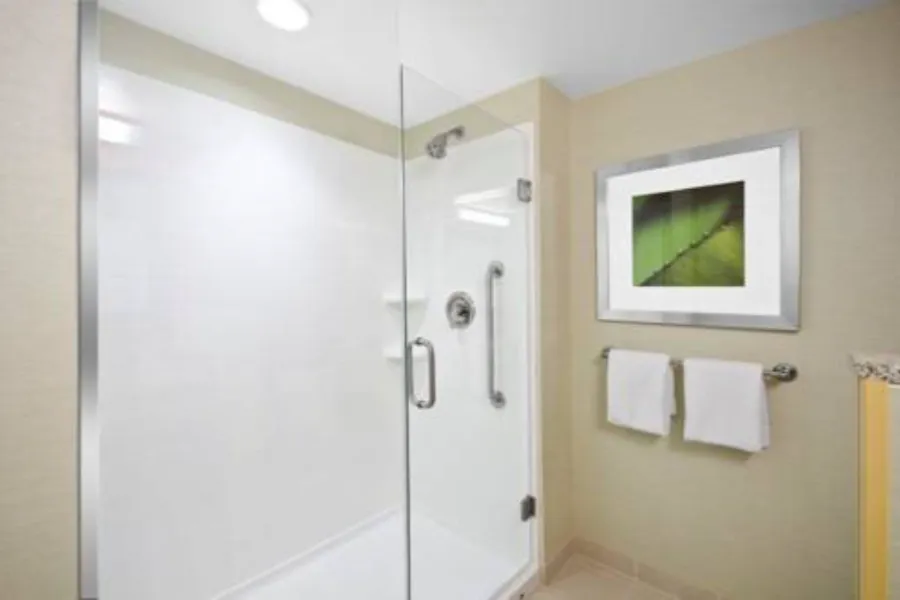
Portes battantes: Max Entry, Max Clearance
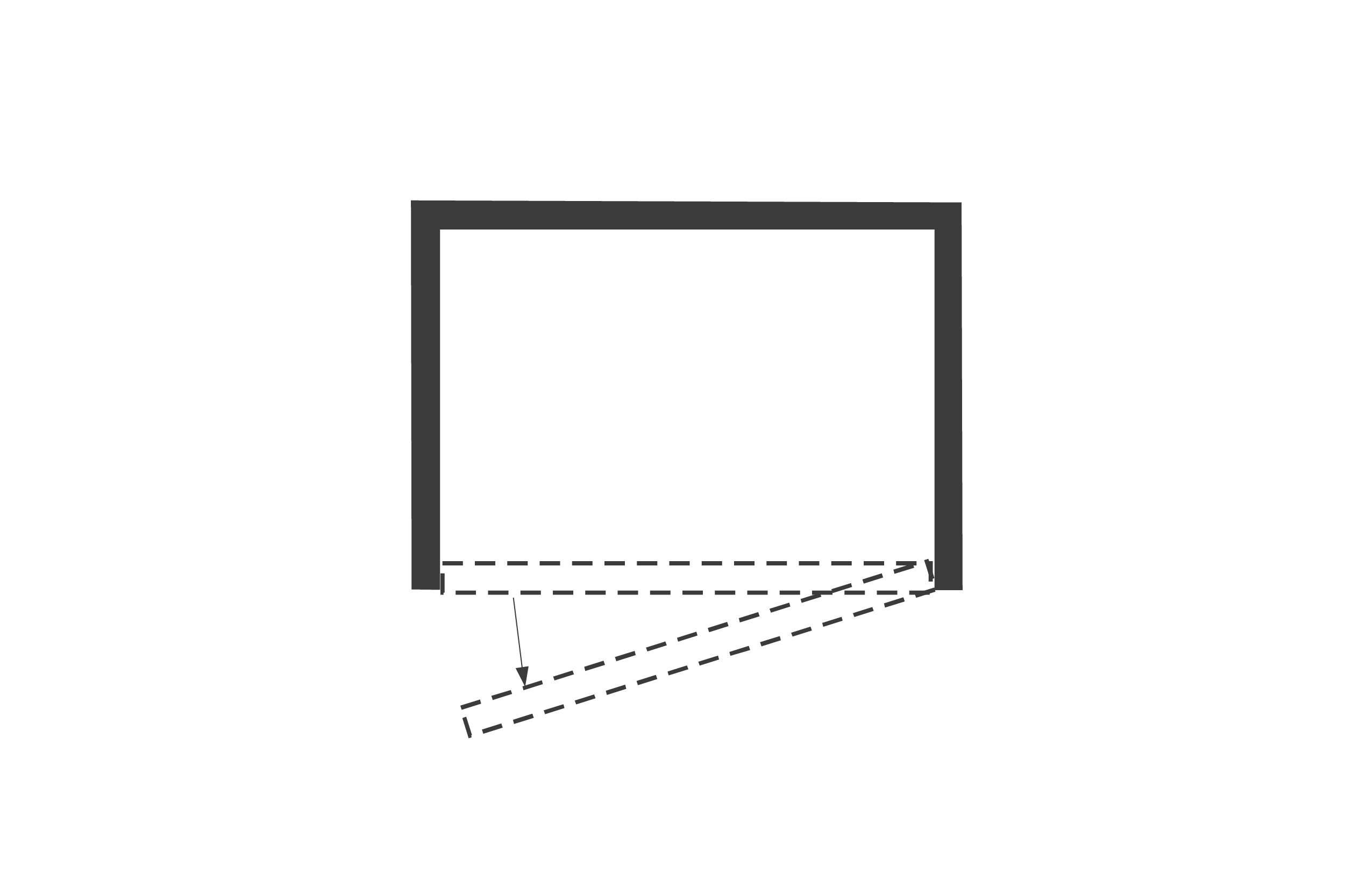
A hinged door hangs on butt or barrel hinges along one vertical edge and swings the whole panel into the room. It delivers the cleanest, widest opening and the simplest sealing line – a straight threshold a single bottom sweep can close against – which is why it is the default where the layout allows it. The cost is pure geometry: the panel’s full width must stay clear through the arc, so a hinged door fails the moment the room door or a vanity sits in its path. The hardware is robust but is a wear point; KJ Bath tests hinge sets to 100,000 open-close cycles and supplies them in a spare-parts kit so hinges can be renewed without touching the glass.
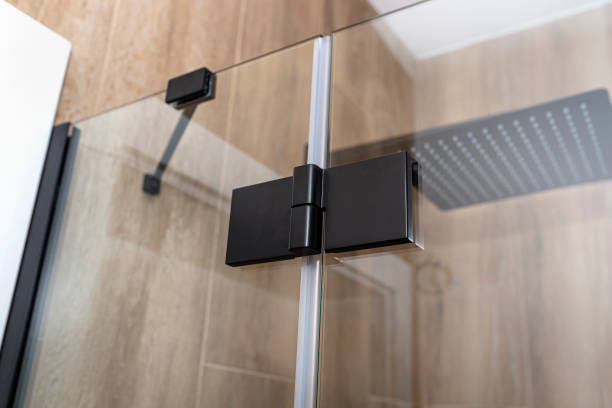
Portes Pivotantes: A Tighter Sweep
A pivot door rests on pins set in from the top and bottom edges rather than hinged along one side, so the panel rotates within its own footprint and clears a tighter radius than a hinged door of the same width. That makes the pivot the middle option for a small commercial bathroom: a broad opening with less swing intrusion. The trade is a double-acting hardware set and a seal line that must work at the pivot gap on both faces. KJ Bath builds pivot hardware in stainless steel and PVD finishes with a corrosion-tested, salt-spray-verified make-up for the humidity and handling of commercial duty.


Bi-Fold Doors: When There Is No Swing Space
A bi-fold door splits the opening into panels that fold against each other and retract inside the enclosure line, so it needs almost no clear floor in front. Where a room door, grab bar, or vanity sits directly at the shower entry – the classic tiny commercial bathroom – the bi-fold is frequently the only door that can open fully at all. The price is more moving hardware per unit and a segmented seal line, which is exactly why bi-fold rollers and hinges are the parts a facilities team should keep in an on-hand spare kit. Within KJ Bath’s space-saving range the folding door is built as the JL710 system; the schematic below shows how the panels collapse.
Side-by-Side for the Schedule
| Type de porte | Clear floor to open | Largeur d'entrée | Hardware wear | Use when |
|---|---|---|---|---|
| Articulé | Full panel arc | Le plus large | Charnières | The layout allows the swing |
| Pivot | Tighter arc | Broad | Pivot pins | You need reach in a tight room |
| Bi-fold | Near zero | Segmented | Rouleaux + charnières | A fixture sits in front of the entry |
One Glass Schedule, Three Hardware Sets
All three door types carry the same glass: 6–12 mm fully tempered safety panels from Xinyi Glass (CIGARETTE), certifié à ANSI Z97.1 / CPSC 1201 et SGCC, the scheme described at sgconline.org, avec CE for mixed portfolios. What differs is the hardware set and its wear profile, so the door choice is really a maintenance-and-clearance choice. On a US or Canadian commercial project dimensioned in inches, KJ Bath fits each door to 1:1 CAD layouts at a 20 tolérance en mm, with cycle-rated, salt-spray-tested hardware and a body-plus-hardware spare-parts kit behind a 5-year door-body / 3-year hardware warranty – the wear-and-service terms are worked through in the roller and spare-parts maintenance guide. For the wider door-family comparison including sliding, see the sliding vs pivot vs hinged breakdown, et le glossaire terminologique des enceintes to keep hinge and pivot distinct in a spec.
Questions fréquemment posées
What is the difference between a pivot and a hinged shower door?
A hinged door hangs on one vertical edge and swings the full panel into the room on a wide arc; a pivot door rotates on pins set in from the top and bottom edges, so it clears a tighter radius for the same opening. Choose a pivot for a small bathroom where a hinged swing would hit a fixture.
When should I use a bi-fold shower door?
Where there is no clear floor in front of the entry – a room door, grab bar, or vanity sits directly at the shower opening. A bi-fold folds its panels inside the enclosure line and needs almost no swing space, making it the only door that can open fully in the tightest commercial bathrooms.
Which shower door type is most durable for commercial use?
All three run on the same 6–12 mm ANSI Z97.1 / SGCC tempered glass; durability comes down to hardware. KJ Bath cycle-tests hinges, pivote, and bi-fold rollers to 100,000 open-close cycles with salt-spray-verified finishes, and supplies a spare-parts kit so the wear items are renewed in place without touching the glass.
Can I standardise door hardware across a small commercial project?
Oui. Because all three types share the glass schedule, you can standardise panels and finishes and vary only the hardware set by room, keeping a compact spare-parts kit across the build. MOQ à partir de 10 sets with 1:1 CAD fit supports a mixed room-type schedule.
Match the door type to your tightest rooms
Send your small-bathroom plans. We will recommend hinged, pivot, or bi-fold doors against your clear-floor and entry targets, sur 6-12 mm ANSI Z97.1 / Verre certifié SGCC installé sur 1:1 dessins, MOQ à partir de 10 ensembles avec un kit de pièces de rechange carrosserie et matériel – pour votre gamme de coffrets peu encombrants.